
Nodaway Arrest Archives Have Limits
The sheriff's Current Inmates page shows who is behind bars now. It does not offer a search for released people, a historical booking database, or any published photo-retention rule. Once a card rolls off, its absence says nothing. The person may have been released, transferred, or removed for a correction. Missouri law sets public-record and closure rules, but it never turns the live roster into a permanent online archive.
For older arrest material, ask the sheriff directly whether the responsive booking record still exists. The official Nodaway County Archives page publishes commission agendas and minutes, and it routes older commission requests to the County Clerk. It lists no sheriff booking files or photographs. State Archives finding aids cover state collections only, and they do not show that county mugshots moved there.
Newspaper archives can preserve a dated arrest long after the roster changes. Use a narrow date range and write down the exact article wording. A historical story is a secondary source, and it cannot answer current custody. Pair it with Case.net when a public court case exists. Read the final disposition there instead of assuming the original charge stayed the same.
Maryville Reports Are a Separate Layer
Maryville's official archive is its own layer. It covers reports and investigations started by city police, and it is not a county booking list. It also skips some dispatched calls. The city posts month-by-month archives for 2023 and 2024, but no comparable daily feed exists. When a city event predates the KVVL archive, search the relevant month first. Then turn to the county jail and court sources for custody and outcome.
Keep the two records separate. The police report describes the city agency's work. The sheriff roster describes county custody. Neither one should quietly stand in for the other.
Nodaway County Multi-Day Arrest Coverage
The sheriff owns no weekly arrest log and no historical booking archive. The strongest county-wide substitute is the 97.1 KVVL police-blotter archive. It holds dated news posts built from local law-enforcement material. A post may name a date, place, incident type, or warrant event. Some entries list an age or a residence. Remember what it is: a news product, not the sheriff's custody database.
One example covered sheriff activity from June 23 through August 23, 2026. It appeared on August 28. That span runs far past seven days despite the "Weekly Arrest Log" label. Nodaway material may be compiled across many weeks. Publication may come only after the period ends. Search by event date and by post date alike.
Read the Nodaway Blotter Carefully
Work backward through dated sources and keep each source's label intact. Never turn an incident report into an arrest, or a warrant mention into current detention.
- Open the KVVL archive and select the month when the report was published.
- Read the title and covered date range. The post date can be later than the events.
- Distinguish incident, arrest, warrant, and charge descriptions line by line.
- Check the sheriff's Current Inmates roster for present county custody.
- Use the Daily Arrest Report when the question concerns a fresh booking, or submit the official sheriff records form for the underlying report.
A person named in an old entry may have bonded out, been released, transferred, or never reached the county jail. The blotter alone cannot say which. For a filed case and its final result, search Missouri Case.net and confirm the identity.
KVVL's Batched Arrest Timeline
The full sheriff blotter example shows one long covered period bundled into a single later post.
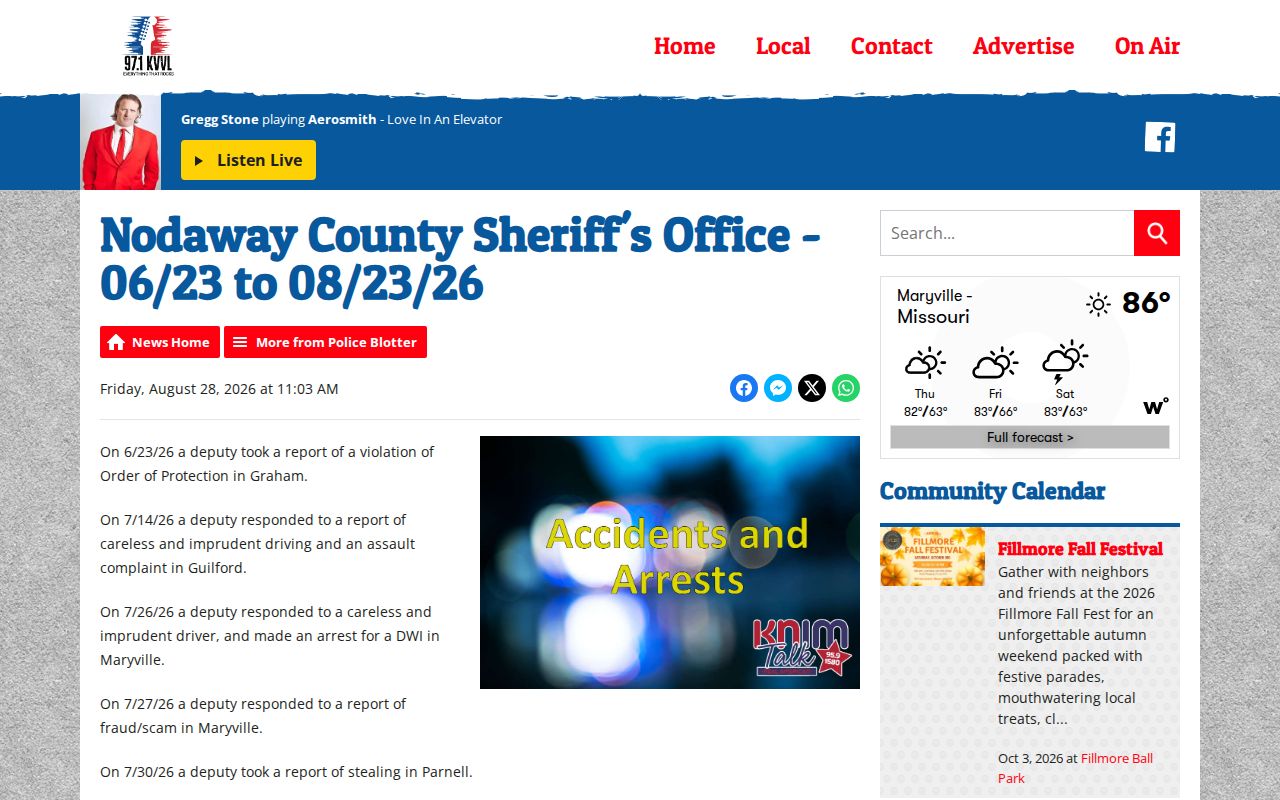
Treat the article as a secondary source. Its publication time and its date range help you locate past events. It does not certify current custody or any court outcome.
The archive also holds an older post spanning December 21, 2025 through February 25, 2026. It was published on March 4, 2026. Taken together, the examples point to batch compilation. They do not point to continuous posting. They promise no fixed cadence, complete coverage, or guaranteed retention.
Fields in a Nodaway Arrest Log
KVVL's text blotter mixes several event types in one place. Read the content as published, then verify important facts at the originating office.
| Field | How to interpret it |
|---|---|
| Event date | Date tied to the reported incident, not necessarily booking |
| Location | Place reported for the incident or enforcement action |
| Incident type | May describe a call, investigation, warrant, or arrest |
| Name, age, residence | Appears in some entries, not all; verify identity |
| Arrest or charge | An charge or reported action, not a conviction |
| Photograph | No routine photo field was visible in the KVVL text blotter |
| Custody status | Not established; use the sheriff roster |
An omitted name does not mean no arrest occurred. A named charge should never be rewritten into a heavier label, either. Prosecutors can amend or dismiss charges, and only the court record shows the later disposition.
Three Speeds of Nodaway Arrest Records
Nodaway County publishes arrest records at three distinct speeds. The sheriff roster is a current-custody display. Maryville's official blotter holds monthly historical police reports. KVVL posts compiled sheriff material in wide batches. Each product answers a different question, so don't merge them into one implied database.
| Source | Window | Best use |
|---|---|---|
| Nodaway sheriff roster | Current custody; duration unstated | Is the person shown in county jail now? |
| Maryville police blotter | Official 2023 and 2024 monthly files | Was a city police report initiated in that month? |
| KVVL sheriff blotter | Delayed, compiled multi-day or multi-week posts | Was an event reported in a broader date span? |
The Maryville 2024 Police Blotter states plainly that it lists actual police reports and investigations initiated by Maryville Police. Extra dispatched calls may never become reports. Read it with that limit in mind.
Browse the Nodaway Blotter Archive
The KVVL monthly archive displays the dated batch structure used for local police-blotter posts.
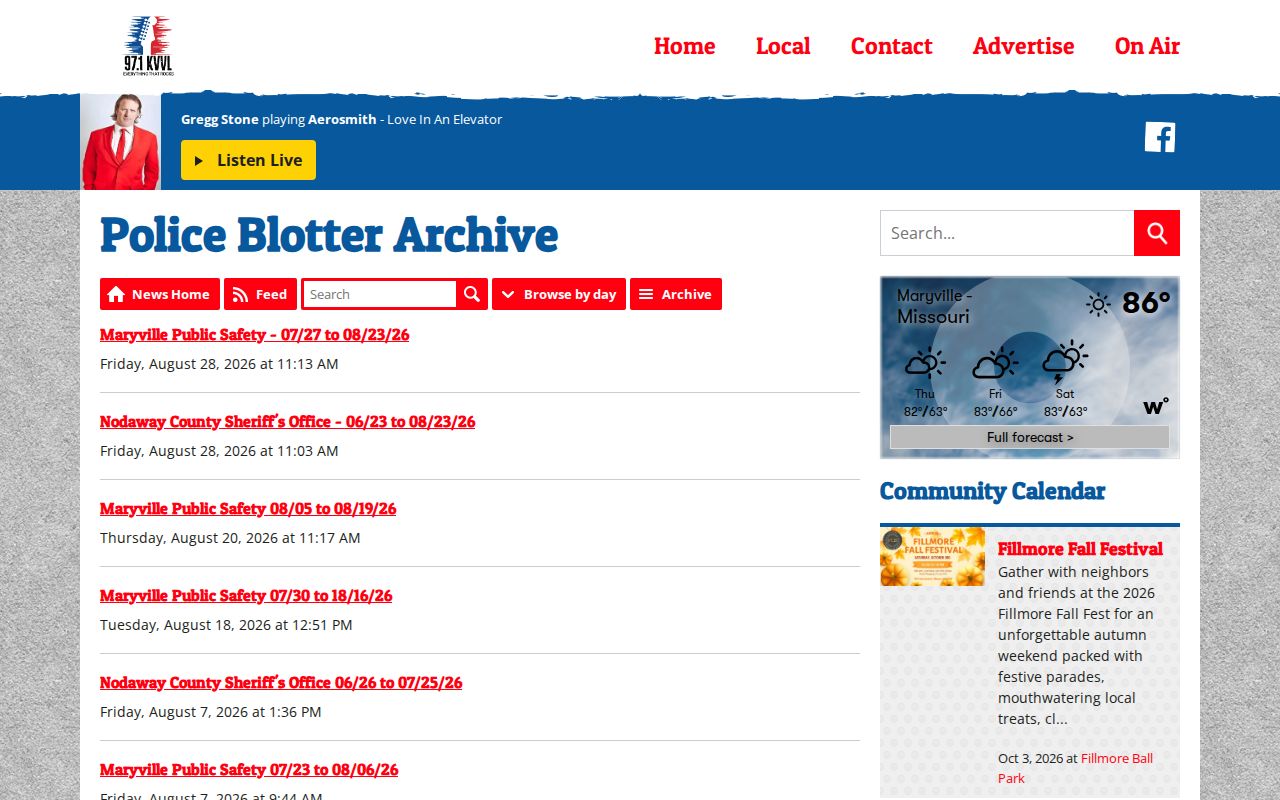
The archive has a practical use. It can recover an article URL after a live roster entry disappears. Treat it as unofficial, though. Coverage can lag or skip events entirely. Nothing about archive storage is promised anywhere. The sheriff keeps no released-inmate archive and posts no booking-photo retention period. When an event is missing from the news archive, file the official Records Request Form with a tight date range, the name, the location, and whether you want the arrest report or the photograph; the form lists no fee or turnaround, so ask the office for current terms.
Local Photo-Bearing Arrest Reports
Start with official sources. Check the sheriff first, then the court. The Maryville Post arrests category works as a secondary lead for some dated Nodaway County Jail Activity posts.
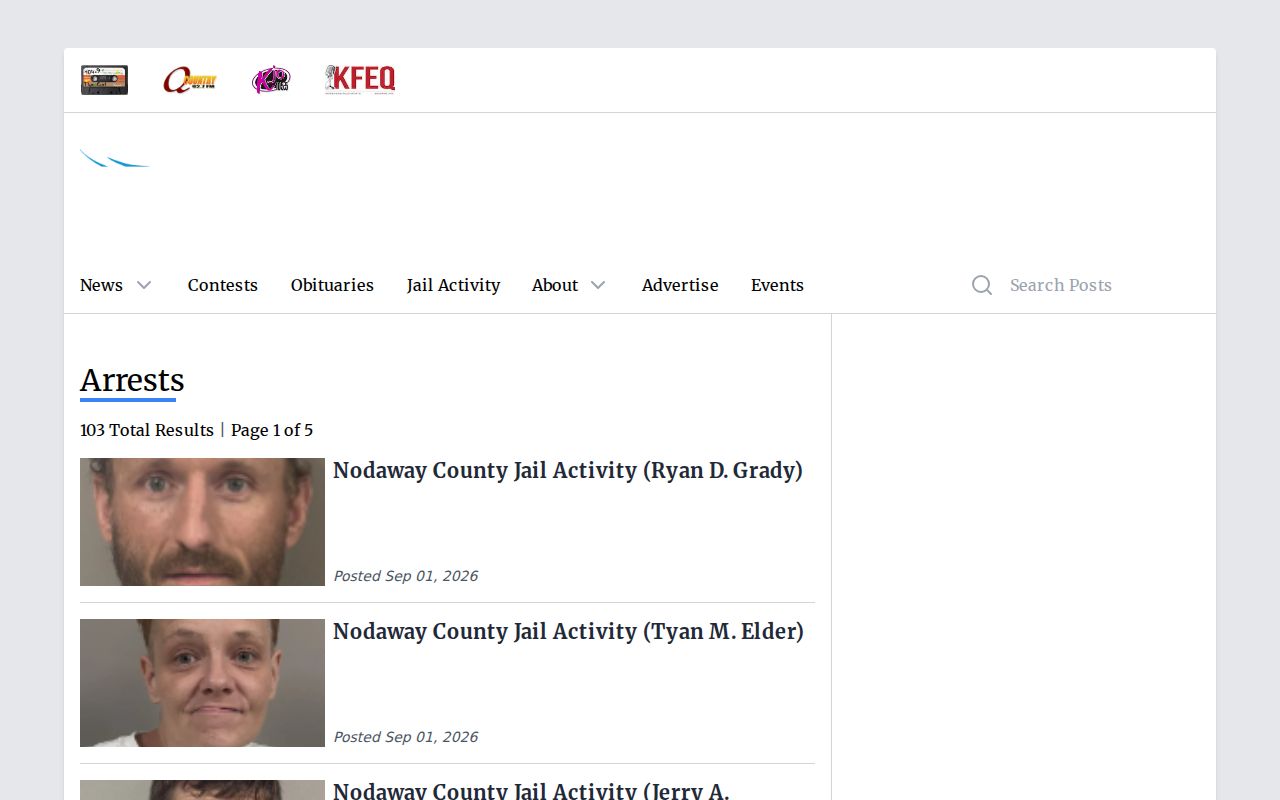
What the category displays varies. Some posts carry courtesy photographs alongside names, charges, and bond details. The outlet controls that content, not the sheriff. Posts can go stale, run partial, or vanish later. For anything official, rely on the live roster, the records custodian, and the court.
Preserve and Verify Older Arrest Entries
The Nodaway County recent-arrests hub ties together the roster, the records process, and the courts. Older entries need careful notes. Record the outlet, the URL, and the publication date. Note the stated event date and the exact wording used. Then ask the sheriff whether the report is still available. County archives advertise no booking-photo collection. Never assume an old image was transferred there.
Missouri Case.net can still show a public case. It can do so long after the roster and the news cycle end. A disposition is simply the court's recorded result. It might be a dismissal, plea, judgment, or sentence. Match the full name and case details before trusting a hit. Charges listed at arrest often change as a case moves forward.
Weekend Arrests May Surface Later
No source promises a Monday roundup. There is no holiday edition either, and no fixed delay after weekend enforcement. Dated KVVL examples show only one thing: material can surface in batches well after events. Search the archive month of the suspected event plus the next publication period, since an article's post date can fall in a later week. Then check the report against the live county roster.
Resist calling a cluster of weekend entries a surge. No source supplies data proving one. A longer post may just cover a longer span. News archive counts reflect editorial choices about collection and publication, not a complete measure of arrests or crime trends.
Public Record Search
Sponsored Results